Sunday, December 29, 2013

Go Easy On Those Music Comparisons Between “Inside Llewyn Davis” and “O Brother, Where Art Thou?"


Oscar Issac as the fictional folk artist, Llewyn Davis.

 
Having read several different reviews for the latest Coen Brother’s  2013 release, “Inside Llewyn Davis” (as well as having seen it),  it’s safe to conclude that Joel and Ethan  have done it once again; creating   another highly successful  mainstream Indie-feeling film.  Indie-feeling based on the film’s smaller budget and scale, and the Coen’s typical non-formulaic approach to both story line and characters.  “Inside Llewyn Davis” asks the viewer to make sense of a few days in the life of a very talented, but near penniless and self-destructive folk musician.   A dreamlike film that at times is uncomfortably realistic, the Coen Brothers have also created a comedy that risks taking its humor a little too seriously.   In other words, The Big Lebowski, it isn’t.  But, it’s a wonderful film that meticulously recreates the place, time and folk music of the west village in New York City during the winter of 1961.  

Reviews from the New York Times, Washington Post, and Salon, to name a few, feel compelled to obliquely reference the Coen’s 2000’s “O Brother, Where Art Thou?” with its inspired use of appropriately placed country and folk songs that also evoke time and place - in this case, the state of Mississippi  in 1937.  (The music for both films tracks is produced and arranged by T-Bone Burnett). 

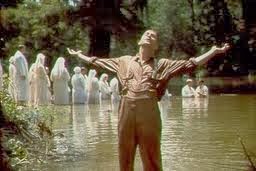
Tim Blake Nelson finds salvation as the baptismal choir sings "Down To The River To Pray"   in "O Brother, Where Art Thou?"
 
Certainly, there’s a comparison to be made between the two films.  “O Brother, Where Art Thou?”  is the Coen’s loosely-based, sunny and often hilarious tour-de-force of Homer’s Odyssey. George Clooney’s main character (Ulysses) escapes prison with two fellow inmates (played by John Turturro and Tim Blake Nelson), in pursuit of great treasure, the location of which is known only to Ulysses.   In contrast, Llewyn Davis has a muted and depressing roundtrip journey to and from Chicago in search of glory and riches (well, hopefully enough riches to rent his own place). An orange tabby cat -  who Llewyn feels obliged to adopt and carry with him as he bums his way around the village and subsequent travels to Chicago – is also named Ulysses.  Musically speaking, the most compelling similarity between the two films (in addition to the inclusion of period American popular music),  is that so much of the period music in both films is performed and sung in real-time, with a few renditions even going beyond a couple of minutes in duration. 

"Lady Killers'" gospel music.


Beyond that however, the two films use their period songs for different dramatic purposes, resulting in a contrasting dynamic. “O  Brother’s” Blue grass, country and folk  songs are mainstream and culturally ubiquitous, ingeniously supporting scenes for baptisms, political rallies, an encounter with seductive sirens (an Odyssey reference) - even a Klu Klux Klan rally.  In fact, only the song “I Am a Man of Constant Sorrow”, spontaneously recorded by the soon to be very popular, Soggy Bottom Boys, is the only music actually used as a plot device, or part of the story.   The music in Llewyn Davis, however, is not mainstream, and representative of the 50s and early 60s folk counter culture.   Scorned by other musicians (such as John Goodman’s pompous and bloviating jazz musician), Llewyn struggles against selling-out when offered an opportunity to become a third wheel in a newly formed folk trio (a clear reference to Peter, Paul and Mary).  

But perhaps the most important distinction between the two films is the casting coup that gives us Oscar Isaac as the forlorn Llewyn Davis.  Mr. Isaac not only beautifully conveys Lleweyn’s anguish and ambivalence, but is actually a very accomplished singer and folk guitarist. The Coens have allowed him to perform live before the camera, something we suspect (despite their faultless lip-syncing) George Clooney, John Turturro, or even the Grand Wizard of the KKK (embodied by Wayne Duvall) are unable to accomplish - live or otherwise.  (In all fairness, Tim Blake Nelson, provides his own signing).    

Conversely, where “O Brother”  showers the audience with a colorful array of different vocal groups, Llewlyn Davis performs a solo (and as we soon learn),  lonely folk act.  When Mr. Isaac as Llewyn Davis opens this film singing “Hang Me, Oh Hang Me” sitting on the stage of an actual, West Village folk club, the Gaslight, he and the Coens seamlessly evoke a poignant trifecta of time, place - and character. 

(In passing, and in the same context, it’s worth drawing comparisons with the Coen’s 2004 film, “The Lady Killers”, which liberally uses African American gospel music).


 But, "No Country For Old Men" had no music on its soundtrack, whatsoever.

Thursday, January 3, 2013

5 Great (and Evocative) Instrumental Movie Themes (Part1)


Going back to the earliest days of early sound, Classic Movie themes have been designed to evoke time and place, identify characters, provide another dimension of emotional support for those characters and - in either explicit or ephemeral ways - underscore the film’s big messages. These themes, which might serve as title music, also provide the melodic and motivic material for creating additional parts of the score. (Of course, this classical approach is not shared by those films going as far back as 1973’s American Graffiti, which rely almost completely on pastiches of popular songs for their sound tracks).

While there’s no shortage of great movie themes, and this wisp of a list could certainly be replaced a hundred times over, the following five movie themes (thank you YouTube), are great examples of this art. (Caveat: Please keep in mind I fully understand there are dozens of great film composers and that Eric Korngold, John Williams, Howard Shore, Danny Elfin and Bernard Hermann – to name a very, very few - deserve their own lists).


1. A Summer’s Place (1959) Max Steiner

A pioneer of early film sound tracks - and the composer for 1933’s King Kong - Max Steiner wrote the tune for this nostalgic and highly memorable top-40s standard. The relaxed, summertime music is the love theme for two teenagers who have accompanied their respective parents to neighboring summer homes.

Steiner's love theme underscores the innocent interaction between the Sandra Dee and Troy Donahue characters, whose relationship soon turns to first love. We know it’s their music because Steiner’s simple, yet soaring string melody is scored over a typical, 50s Rock & Roll triplet accompaniment, supported by woodwinds and a subtle (for the time), pop rhythm section.

 "A Summers Place".


2.   Dr. No (1962) Monty Norman/John Barry

Monty who? The late John Barry scored 11 James Bond films, but actually did not write the Agent 007 Theme. Monty Norman, a lesser known theater composer, deserves that credit (and royalties). But Barry, in addition to creatively employing the theme and its motifs across all his Bond films (Dr. No through Octopussy), deserves the credit for first arranging Agent 007 signature theme in its iconic, jazzy style. 50 years after its debut – and dozens of James Bond films later - the signature 007 Theme has yet to be discarded and is still recognizable (if just barely), as in the most recent Bond production Sky Fall.

With its pungent harmonies, punchy, syncopated rhythms and cutting-edge scoring, this theme tells us everything we need to know about its protagonist. He’s a cool, sexy hipster who bests his opponents and always keeps his act together - despite engaging in highly dangerous and life threatening situations.

And everyone loves that final electric guitar chord: E Minor/Maj7/Maj9!


3. My Body Guard (1980) Dave Grusin

For this smaller budgeted indie sleeper, Dave Grusin makes an inspired choice. In scaling his instrumentation to a modestly sized chamber orchestra, he ingratiatingly supports My Body Guard's coming-of-age story and its wistful sense of nostalgia. A string quartet is used to good effect in evoking a youthful and sunny hopefulness. The main theme appears under the title, gracefully unfolding in ¾ time as Clifford, a high school student, rides his bike through the city of Chicago.

                                      " My Body Guard": Main theme and title music.


Thursday, September 20, 2012

Switched-On Chaplin


When I was a teenager just beginning my musical journey as both musician and wannabe musicologist, I came across Walter Carlos (just prior to his Wendy conversion), and his/her series of ground-breaking, Switched-On Bach recordings. These adroitly and painstakingly Moog synthesized, electronic adaptions of Bach, Handel, Monteverdi, and Scarlatti (realized more in the abstract than as explicit instrumental recreations), captured both my imagination and generated a profound interest in the music of the baroque period.  Carlos’ own sonic interpretations of the Brandenburg Concerti, Handle’s Water Music and selected Scarlatti keyboard works, produced a highly accessible portal which ultimately led me to the original scores and their recordings.  Not so long ago, I heard a few tracks from the first Switched On Bach recording and was taken aback by how technically dated and musically monotone they seemed.  Nonetheless, I still feel indebted to the recordings and their creator for opening the door to literally a century’s worth of wonderful music. 
   
And with this as the most incongruent of preambles, I hope Chaplin: The Musical!, which opened at the Ethel Barrymore Theater on September 10th, will inspire its audience to look-up some of Chaplin’s Mack Sennett one reelers (35 produced in 1914); or the best of his work at the Essanay Film Studio (15 in 1915); all of the Mutual Masterpieces (12 from 1916-17); the First National productions  (including “A Dog’s Life”, “Shoulder Arms” and “The Kid”) -  and the sublime and indispensable United Artists feature films (beginning with “The Gold Rush”, and followed by “The Circus”, “City Lights, “Modern Times”, “The Great Dictator”, Monsieur Verdoux – and ending with “Limelight”).
Chaplin in The Gold Rush, 1925
For myself however (and, yes if it’s not clear by now, I am a Chaplin fan and aficionado), I don’t feel especially compelled to buy a ticket; much for the same reasons I wasn’t terribly enthused about seeing a  two-act musical called “The Civil War”.  I just think putting Chaplin on the stage for a musical biop risks being disappointing for the initiated - and absolutely maddening for the devotees. 
                                                                        
Look twice: Chaplin imitator Billy West, c. 1918
Firstly, and generally speaking, shows about silent film comedians always (and no pun intended) sell their subjects short. Directors and actors get the clichés, the broad strokes and superficial characteristics without understanding the driving impulse, timing and genius behind inspired physical comedy and sight gags. 

Personally, I hate outer directed Chaplin impersonations. I find they tend to be all derby and no Chaplin. Having not seen the Chaplin musical, I can’t speak for Doug McClure’s well-praised performance as the “Little Tramp”, but honestly:  Lucille Ball, Robert Downey, Jr. – even Billy West, an early screen contemporary of Chaplin, who did an extremely convincing job of essentially ripping off Chaplin’s act - couldn’t come close. The costume can be correct, the body-type close enough – even the basic physicality can appear, seemingly spot-on.

And yet, not one performer I’ve ever seen seems to understand the inventiveness and subtlety of Chaplin’s facial pantomime and economy of gesture; not to mention that under the make-up, moustache and pratfalls was a great comic actor.

For that, switch-on a Chaplin two-reeler.   


Saturday, February 4, 2012

Travel Tips for New Orleans: Bring Cash

I only needed one weekend In New Orleans’ irresistible French Quarter to nearly spend $200.00 in small gratuities. Solo street musicians,  bands, jugglers, human statues (witness Bourbon Street’s hard-hatted construction worker, posing motionless on his ladder while holding a two-by-four over one shoulder for hours on end),  hip-hop dancers  and hucksters -  the last group offering   more in the way of desperation than talent – all had their hand-in for a hand-out   By the time Saturday night rolled around, when Sue, (my traveling companion), and I observed  a  roach  crawling across the very old bar at The Spotted Cat  on Frenchmen Street , I didn’t know whether to kill it -  or tip it.


But for me, New Orleans has always been about the music. And if the Dixieland revival of the 1940s began a touristy homogenization of the music created by King Oliver, Louis Armstrong and Jelly Roll Morton in the first few decades of the 20th century, ultimately resulting in non-stop performances of “When The Saints Go Marching In” at Preservation Hall – and just about every place else in town - it’s still New Orleans. And I -  like others early jazz aficionados -  wouldn’t dream of not going.
The Hokum Highrollers
There are definitely two strata of musicians in New Orleans: those that are paid by salary or a percentage of the door cover (including headliners), and those that work exclusively for tips.

Of course, the street musicians, solely dependent on tips, are the most visible.  They dress in clothes of an indeterminate, but somehow indigenously convincing, bygone era.  Many groups bring along  their pet dogs who either sleep or wag  their tails in time to the music.  Adapted plastic water jugs and instrument cases are open for tips, with hand lettered cardboard signs requesting $1.00 per photograph.  Some try to imitate the virtues and limitations of the old New Orleans jazz and country-folk styles with varying degrees of success.  At worst, they seem creatively trapped by it.  At best, you can hear and feel - even from the very young players just past their teenage years - a genuine yearning to make it all new and relevant.
             
Thanks to the digital age and the internet, a few of the street bands offer up inexpensive CDs.  The polished and talented Hokum Highrollers, comprised of guitar, banjo, fiddle, string bass and trumpet can be viewed on www.facebook/thehokumhighrollers   For their street concerts, they offer up an old-time, swinging, string-band sound, replete with southern vocal twangs and kazoo.   Amanda Blake on trumpet (fighting off a cold when I saw here), employs an empty soda cup as a mute and tap dances; her metal taps (in addition to being entertaining), provide an inventive alternative to woodblocks or spoons.

These guys really nailed the string band sound of the early  30s.

 
While the Hokum Highrollers are attempting to brand themselves, many street musicians move back and forth between pick-up groups.  One afternoon I cited a country guitarist/singer in three different bands in the French Quarter.


If you want to weave in and out of a very inexpensive and rewarding club scene, however, Frenchmen Street  has  numerous restaurants bars and clubs – all noted for their music, accessibility - and some for a delectable seasoning of sleaze.
 
In just about any other city or town, The Spotted Cat is a bar that would have to be considered an old and unmitigated, mangy dive.  But somehow, on Frenchmen Street - with its joyously maintained and seedy authenticity (and a portrait of my man, Jelly Roll, above the bar), I found it down-right exotic.  For the price of a one-drink minimum, we were unexpectedly blown away by the Panorama Jazz Band.  Comprised (on this night), of clarinet, sax, trombone, sousaphone, accordion and drums, the ensemble brilliantly played inventive and tight arrangements of an eclectic series of jazz and Klezmer inflected tangos, waltzes, horas, and marches.  Once I heard this group, I had absolutely no desire to move on to other destinations.


The Panorama Jazz Band, at The Spotted Cat
But despite my experience over the last two days – and given the quality of their performance – I was still surprised when the sousaphone player, Jon Gross (recently nominated by Offbeat Magazine for “Best Tuba/Sousaphonist” in New Orleans, who’s maybe 5’7” tall), stepped off the stand in the middle of a tune, and waded through the customers, soliciting tips – still performing -  and without dropping a single note or beat.  Playing the horn’s valves with his right hand, he held the ubiquitous plastic gallon water bottle aloft with his left - secured by his three middle fingers - while managing to hold two different CDs between his thumb and index fingers.  Was I impressed?  Let’s just say I wasted no time in taking a CD and dropping a twenty into the plastic bottle.
  
In talking with the trombonist, I learned the band seldom played outside of New Orleans – which somehow, was just what I wanted to hear.  The Panorama Jazz Band rounded out the short stay beautifully.  My final musical, New Orleans tip-touch-point before heading back to Jersey.


This unknown clarinetist really wailed.


But wouldn’t you know it: as it turns out The Hokum Highrollers hail from Burlington, Vermont.


Tuesday, August 2, 2011

In Musical Theater, the Adapatation's the Thing


What do Stephen Sondheim’s Pacific Overtures, William Finn’s Falsettos and Bill Russel’s and Henry Krieger’s Sideshow have in common?  They all belong to a rarified group of broadways shows that were not adapted from preexisting properties. 

But theater, after all is still a business, and while true inspiration is in the eye and ear of the creator, true pre-marketability is foremost in the minds of producers and investors.  And that’s understandable.  With production costs soaring into the tens of millions of dollars, who wants to put money into some property or concept that hasn’t been market tested? 

Thus, the adaptation’s the thing.  Presenting investors with a commerically proven subject area considerably ups the odds of an actual production. Adapting a successful film, television show, book, short story, or even comic (Spiderman, of course, comes to mind – but leave us not forget the 1960s Superman), provides a ballast when pitching to money men (or Angels), not to mention mitigating the need to over rely on their imagination.  Additionally, presenting a potential musical vehicle as part of an preexisting, larger franchise or catalogue, makes a great case for increased, and follow-on investment opportunities.

Does Broadway love adaptations and franchises?  You bet! Lion King meet Beauty and the Beast, Aida– and Little Mermaid and Tarzan, and arguably, Mary Poppins.  No coincidence here. Disney’s animated film adaptations of children’s stories, re-adapated for the Broadway musical, are tourist and kiddy catnip. (Like investors, tourists typically want to spend their vacation dollars on a known quantity).

The Disney franchise may have been weakened a bit by the less than stellar Little Mermaid - and certainly Tarzan - both falling below ticket sales expectations.  But as any parent of the last 20 years can tell you, the Disney franchise of adaptation still has plenty of juice left.  Hopefully, Disney will  forego an adapatation of the animated film version of “Hunchback of Notre Dame”, sparing us a deaf Quasimodo belting out love ballads (not to mention the choreographic temptations of all those bells and ropes).   

Composer, Frank Wildhorn and lyricist Leslie Bricusse, (whose investors, one speculates, desired to emulate Andrew Weber’s success with his musical adaptation and entry into the horror franchise, Phantom of the Opera), made a big commercial splash with their adaptation of Robert Louis Stevenson’s book The Strange Case of Doctor Jekyll and Mister Hyde.  Running, 1,543 performances.  Jekyll and Hyde’s success begged for a follow-up adaptation.  The appearance of Dracula, the Musical, Wildhorn’s next vehicle in the genre  - celebrating another highly-sexed maniac who relishes the night-life) -  was probably not a huge surprise to Broadway theater-goers.


And surely, the appearance of Young Frankenstein was not a shocking development in lieu of the mucho mega-hit that was The Producers -  signaling the start of a Mel Brooks franchise adaptation series.  Young Frankenstein, in fact, is a serious contender for the Most Adapted Show of the Decade!!; being an adaptation of  Brooks’ film from 1974, which is a satirical adaptation of the 1931 James Whale film, which is based on Mary Shelley’s gothic novel of 1818, which, itself, is based on the Prometheus legend from Greek Mythology.

But, commercially speaking, Young Frankenstein faring only a fraction as well as the The Producers, may have tabled the continuance of the Brooks broadway brand. 

Which is to say, you probably shouldn’t worry too much about holding your breath for the “Flatulence Fandango” adapted from the cowboy bean-eating scene for Blazing Saddles, the Musical!

The Youngest Frankenstein of them all!  Thomas Edison's Frankenstein one-reeler from 1910.


Friday, July 8, 2011

Three PhD Dissertations on Jazz - I Won’t Write.

As I concluded my graduate work toward  my MA in music composition at CUNY (including my thesis piece, a two-movement, atonal string quartet), there was the immediate, somewhat knee-jerk assumption I would move right along into the PhD program in composition.

I didn’t - and since then, the earth has cooled considerably. Now, if I were to pursue a PhD, I’m fairly certain it would be in jazz studies.  But as the years roll on, even that seems unlikely.  Consequently, I’m prepared to throw open for consideration - and surreptitious appropriation - three subjects for possible dissertations.


Coleman Hawkins
  1. Coleman Hawkins- and His History of Jazz


When Ken Burns made his milestone documentary “Jazz” (2000), he used both Louie Armstrong (1901–1971) and Duke Ellington (1899-1974) as referential, connecting threads to help ground his story’s chronology and construct. After all, both Armstrong and Ellington were there at the beginning of Jazz’s luminous second generation of players and composer/arrangers (the first generation - Buddy Bolden, etc. - being extremely under represented by recordings – if at all).  Both Armstrong and Ellington lived well into the period of avante guarde and free jazz.  Their deaths, in fact, came at a time when a good deal of jazz had settled into a comfortable and more commercial homogenization of late swing and be-pop.

Armstrong, by virtue of his historic longevity, tremendous commercial output, and highly affable and accessible media personality, provides a strong emotional tie-in for Burns’ 19 hour opus. As an innovator, however, no one would argue that Armstrong continued to evolve past the mid 1930s.  Ellington did evolve, however. As a composer, he continued to grow harmonically, rhythmically and structurally.

So, it is more with Ellington in mind that aligning the study of jazz with the ongoing and cutting edge development of a seminal performer, such as tenor sax giant, Coleman Hawkins, strikes me as compelling idea and a justification to take yet another, but hopefully, different PoV for an in-depth study of jazz (By the way, if you can find a like performer that would qualify for a similar study – I’d love to know about it). 

Coleman’s discography begins in 1921 as a 17 year old sideman for blues “Queen”, Mamie Smith and her “Jazz Hounds”.  Listen to the down and dirty, polyphonic instrumental ensemble on “Crazy Blues”- and then compare that to Coleman’s tenor sax solo (not to mention the rest of the very well, and tightly arranged, Fletcher Henderson Orchestra) in the 1924 recording of “Sugar Foot Stomp”.  Now, imagine the same instrumentalist playing with Django Reinhardt, Charlie Parker, Dizzy Gillespie, Thelonius Monk and Max Roach - to mention just several great and innovative musicians. 

But before you explore those recordings, listen again (and how lucky for you if it’s the first time), to Hawk’s 1939 recording of “Body and Soul”.  This, in my estimation, would be the centerpiece, the “golden mean” of this suggested dissertation.  As well as the place and time that Hawkins became an undisputed leader in the world of jazz.

  1. The Evolution of  Swing in Jazz Ensembles & Rhythm Section – 1917- 1955
The late Lance Hayward - the blind and gifted jazz pianist from Bermuda - used to play solo at the Village Corner on Bleeker Street in Greenwich Village back in the 1970s and 80s.  Given there was no cover charge, inexpensive brews, and Lance’s very long sets, it was an irresistible opportunity to hear really fine jazz piano.  During breaks, Lance was accessible and available for conversation – no matter how pretentious or silly. 

Once (during one of my deeper moments), I asked, “How do you define jazz?” 

“The only thing I know”, said Lance, rather modestly, while snapping his fingers, “is that you feel the beat on two and four.  Jazz is on two and four.”  (If you’re unsure what this means, watch video of Sinatra snapping his fingers along to Nelson Riddle arrangements).

The "Original Dixieland Jazz Band" as they appeared in 1917. (Note the size of the bass drum).
But Lance’s definition would exclude most everything from the earliest days of jazz recording (arguably beginning in 1917 with the “Original Dixieland Jazz Band”) through mid-period swing (into the late 1930s) and a lot of Latin feels that are essentially 8/8.  Of course, this is where it becomes interesting.

The general notion of swing is that it has become standardized.  Having written more instrumental theater arrangements then I’d care to admit, I’ve been asked consistently over the years if a particular arrangement, or passage, is “swung”.  If I say “swing it” - amazingly - everybody seems to have a great sense of the same, if generic interpretation.  In fact, the majority of performers would assert exactly how a writer should represent swing through actual notation.  (With no automated notation available, I’ll describe what everyone probably expects: If, by example,  a line is comprised of ten “swinging” eight notes, the “swing” conversion would be notated by five triplets; the first sound ((within each triplet)), being represented by a quarter-note,  and the second sound by an eight note).

We see this convention all the time in bluesy pop-music and theater scores.  An alternative to the pesky triplet notation would be changing the beat unit to a dotted quarter and the meter to 12/8.  What most of us prefer, however, is writing straight 8th notes and simply indicating “Swing!”   

And yet, the earliest recorded jazz (1917-1930) defies this application of conventional swing. Listening to the earliest ensembles, we hear swing expressed as a feel somewhere between syncopated march-time and a more relaxed triplet feel; oft times occurring in the same recording, and represented by different players. A great example of this occurs in any number of Armstrong’s solos from his Hot Five and Hot Seven recordings (1925-1929). Listening to Armstrong’s double-time passages (clearly nascent versions of Lance Hayward’s two-and-four swing), one can’t help be struck by the jarring juxtaposition his sense of swing evokes when compared to the older style of his colleagues.

But since I’m not writing this dissertation, here are a few thoughts for exploration regarding the evolution of the jazz rhythm section and its advancement toward the modern sense of swing:

  1. The supplantation of tuba by string bass.
  2. The abandonment of the woodblock
  3. The abandonment of the banjo
  4. The creation and expanded use of the high-hat
  5. The development of the ride cymbal
  6. The introduction of the Count Bassie ‘comp’ style

Of course, if your goal is not to write this dissertation, but to recreate the sound and integrity of early jazz ensembles, ignore a. (Jelly Roll Morton and his Red Hot Peppers re-creationists, excepted), and b and c.

  1. How the Invention of Sound Recording Impacted the Development of  Early Jazz 

My third possible subject for a jazz dissertation is undoubtedly the most difficult to execute and substantiate, clearly (or perhaps because there’s lack of clarity), the most theoretically convoluted, and – for the aspiring scholar and musicologist – the most risky and dangerous.  In other words, it’s potentially the most worthy of the three.

Putting aside cinema (which organically grew with, and was inextricably bound to the invention and ongoing development of film as a medium), has anyone ever attempted to link the development of an art form with a particular mechanical media in such a holistic manner? 

Surely the early recording process must have had a developmental impact on an art form increasingly based on improvisation?
The germ of this idea actually began when listening to a 1906 acoustic recording of Mimi’s aria from Puccini’s La Boheme, Si, mi chiamano Mimi . At one point I realized I was hearing an echo of Mimi’s aria in the orchestra played by a flute, instead of its usual representation on harp, as orchestrated by Puccini. This had everything to do with the technology of the one, or two horn, acoustical recording process unable to capture the delicacy of the plucked harp. Needless to say, technology caught up with the finer points of Puccini’s instrumental and vocal requirements, as it did with all preexisting and subsequent orchestral, band, choral, and chamber music. I don’t know whether this type of practical substitution annoyed Puccini, or if he even cared about his music being recorded. I’m certain, however, it did not impede his creativity or thwart his development as a composer. Neither did it ultimately misrepresent his intentions. Any music student of 1906 could review Puccini’s instrumentation in his score, or find a performance that faithfully realized the composer’s intentions.

But in 1906 sound recording was in its nascency. And so was jazz. Arguably, they grew up together. Further, unlike classical music, jazz was an aural phenomena; its players a mix of educated music readers and “head” musicians. Stock arrangements existed, but were loosely interpreted with actual performances containing worked out, or improvised two-bar breaks and freely expressed rhythmic and melodic tune variations.

Without the written scores, which only suggested improvisation amd the use of blues, aspiring jazz players learned by hearing it live or listening to recordings.

If we assume the conductor and sound engineer accommodated the limitations of the recording process by swapping out a harp for a flute in the 1906 La Boheme aria, what might the impact have been to the earliest jazz recordings, and in-turn, how did the perception formed through those recordings impact jazz’s development?  In other words, what degree of musical compromise are we experiencing in this early collaboration between musician and engineer?

Here’s a short list of examples citing how technical limitations impacted recorded, early jazz performances:
  • 1. Recordings tended to run under 3 minutes
  • 2. Drummers tended to favor woodblocks, which were audibly much brighter than snares and tom-toms and cymbals.
  • 3. Tracks weren’t mixed – players were mixed. (e.g., the classic tale regarding Louis Armstrong being told to stand 10 feet behind his first recording ensemble, “King Oliver’s Creole Jazz Band”, because of the power of his sound).
  • 4. In general, recording could be decently or poorly mixed through the positioning of players. Poorly mixed recordings were particularly injurious to the polyphony of early jazz.
  • 5. The state of recording actually made piano-rolls a viable alternative into the mid 1920s.

In conclusion - -any takers?