Friday, February 27, 2015

The Romance and Scandal of Dickens & Nelly


Dickens & Nelly, a New Musical. 
 Books/lyrics by Barbara Zinn Krieger; music by Charlie Greenberg


 In 1858, Charles Dickens’ affair with Nelly Ternan, (the actress more than 25 years his junior), had become public enough to compel Dickens to publish a denial:  

I most solemnly declare, then -- and this I do both in my own name and in my wife's name -- that all the lately whispered rumors touching the trouble, at which I have glanced, are abominably false. And whosoever repeats one of them after this denial, will lie as willfully and as foully as it is possible for any false witness to lie, before heaven and earth".

In the new musical “Dickens & Nelly”, this spirited defense of Dickens’ integrity and Nelly’s virtue is dramatized during a confrontation in London’s Anatheum Club.  Having mocked Dickens for trying to hide his affair, authors, including hypocritical Willkie Collins (“I do as I please with both my women”), Anthony Trollope, George Wills and William Makepeace Thackeray are excoriated by an enraged Dickens.  Dickens’ words soar in a new musical theater piece that understands there’s rarely as much heated and continuous passion as there is in an illicit love affair.

Dickens is a control freak.  He orchestrates the affair through selective confidants and a mastering of train schedules. Exploiting his prodigious fame, charm, and the vacuum created by an absent father figure, he seductively isolates Nelly (the youngest of three sisters in a theatrical family), from her siblings and mother.  To protect his reputation, he surreptitiously moves Nelly from location to location over a period of 13 years, adopting an alias for them both.   

But, Dickens loses control.  His wife discovers the affair, Nelly becomes pregnant, and the train crashes - with both Dickens and Nelly onboard.

Ultimately, Nelly rejects victimization and reinvents herself, while never compromising her past love for Dickens.  In fact, she is a survivor of a love affair that didn’t publicly begin to see the light of day till the mid 1930s – 20 years after her death.

Dickens & Nelly will receive a staged reading under the musical direction of Warren Helms

Location: Black Box Theater @ William Paterson University in New Jersey.
Date: Sunday, April 19th @6:00PM
Admission: Free  


Thursday, January 29, 2015

5 Tips for Overcoming those Pesky Piano Performance Anxieties


This is a guest blog by the less than legendary, Louis C. Monteverdi
http://charlie-greenberg.blogspot.com/2011/06/confessions-of-louis-c-monteverdi.html


As a pianist performing regularly in front of live audiences (well, at least they claim to be), I still struggle with hand jitters, wrong notes, inaccurate rhythms and sudden sonorities of unknown origin. 

While I know of no real remedies or telethon-type activities related to alleviating this aggravating affliction of unaccountable nerves, I can offer the following five tips in the hope that they may prove useful in times of classical piano’s annoying nuances. 

  • TIP #1: Come Early Before the performance


Avoid increasing your stress level by leaving sufficient time for a preparatory period of relaxation. Relax, compose your thoughts and slowly exercise your fingers with unrelated abstract, technical studies till you have achieved a certain comfortable level of digital dexterity.  

  •  TIP #2: Completely Ignore Tip #1


Don’t come early, fool!  That will only make you even more uptight by creating a misguided sense of importance about the whole stuffy business. Better to come a little late. Have a couple of smokes, a couple of beers.  Too bad, if people get pissed off and decide to leave because it’s already 8:15PM.  Screw ‘em!  Keep repeating to yourself “Screw ‘em. It’s just not that important”.  Relax; the whole thing’s just this side of being a complete waste of everybody’s time. 

  •  TIP #3:  Disrespect the Composer.  Does he think he’s better than you!!? 


 Screw Beethoven, the ugly son-of-a-bitch. Clearly, the guy was never successful enough to afford a facial or get a decent haircut. What’s that, lady, I was hitting wrong notes?  What do you expect, the guy was frickin’ deaf when he wrote this damn thing!  Give me a break!

  • TIP #4: Make Sure the Piano is in an acceptable  State of Disrepair


Sure I’m nervous.  Wouldn’t you be if you had to perform on this reject from a down-market Salvation Army post?  I mean, I might have warmed up, but I ran out of time while I was Gorilla Gluing  all the broken keys back on, for cryin’ out loud!

  • TIP #5   Just Go Play Cocktail Piano


Find a restaurant with a big room full of noisy people whose voices bounce off a carpet-less, slate floor, utterly drowning out the sound of your dwarf baby-grand with zero amplification. All that’s missing is a black cape and hood - and a Lone Ranger mask.  Then you can be nervous all you want. 

Sunday, January 25, 2015

Scott Joplin’s “Euphonic Sounds” vs. Jelly Roll Morton’s “Freakish” - - Classical Aspirations vs. Modern Accommodation

 
Scott Joplin


Jelly Roll Morton


We celebrate both Scott Joplin and Jelly Roll Morton as American originals and classicists. Joplin (1867-1917), as the “King” of classical ragtime composers and Morton (1890-1941), as a progenitor of what has come to be considered early jazz, both as composer/arranger and (thankfully),  recorded performer.    

Joplin was a classicist in the most traditional and technical sense.   His piano writing adhered to European music theory practices in harmony, voice leading and compositional form.  (For example, there’s little difference between the highly, formulaic musical structure of Joplin rags and Sousa marches: AA/BB/A/CC/DD). 

The magnificent results of Joplin’s’ genius was his blending  of European classicism and African American derived folk melodies -  both inextricably bound to  a uniquely  subtle and sophisticated binary, ragtime syncopation.  (On occasion, there is even an early suggestion of blue-notes  - flatted 3rds, 5ths - but these are always supported by conventional harmonies or quickly resolved as non-harmonic tones).    

 “Euphonic’s Sounds” (1909),  comes from a particularly rich year of Joplin rag composition. It also coincides with the beginning of Joplin’s obsession to write his grand, ragtime opera, “Treemonisha".   By 1907, Joplin had moved to New York City in order to be in a more compatiblle cultural environment that might artistically and financially support a staging of “Treemonisha”.

All this is to say,   if you’re familiar with Joplin as the composer of “Maple Leaf Rag”, “Easy Winners” and “The Entertainer” – you may well be surprised by Euphonic Sounds' very ambitious and surprising composition.

Clearly, Euphonic Sounds is a rag. It adheres to Joplin’s (and generally), classical ragtime's consistent use of sequential  16-bar strains.  Certainly, its 4-bar intro and first theme sound fairly much like business as usual.

The second theme, however, is where the traditional ragtime wheels come off, and even the initiated may think they’re losing count.  Yes, there are plenty of two-bar repetitions as befitting Joplin’s 16-bar strains, but in “Euphonic Sounds”; they serve an entirely different purpose.

To illustrate this point, let’s look at the arch-typical second-strain of  Joplin’s 1908 rag, “Fig Leaf”.

Here, the 16 bars strain conforms to 2, clearly defined -8 bar segments, divided into 4-bar phrases with clear thematic reiteration:

2nd Strain: “Fig Leaf”

----------- 16 bars ------------

1st half:  4+4: 2nd half: 4+4)


 Conversely, and quite atypically, “Euphonic Sounds'” second strain creates a 16-bar, through-composed arc, whose melodic material evolves through several jarring modulations, reaching a highly romantic climax at bar 13:


Additionally, as Rudi Blesh and others have noted, there is a suspension of the traditional bass-note-chord construct, a hall mark of not only ragtime in general, but upcoming stride piano playing.  


Stride pianist, James P. Johnson (for one), cited “Euphonic Sounds” for its modernism.  But while mind reading should never pass for scholarship, was Joplin’s rebellious  2nd strain  in Euphonic Sounds  more focused on expanding his concept of ragtime into another form of classical music, or  even so-called, serious modern music?  


And what was Jelly Roll Morton thinking when he imposed the descending, parallel  voicings  of disorienting  dominant 9th chords in 1929’s “Freakish”?  


Was Morton, on the cusp of being passe, thinking of cornetist, Bix Beiderbecke’s 1926 foray into impressionism called “In a Mist” (played quite well, actually, by Bix on piano)?  Or, was he simply  trying to say,  Don’t tell me, I get this modern stuff!”  And if he did get it, he may well have signaled  he didn’t much care for it my calling his composition “Freakish”.


Don’t get me wrong.  I love “Freakish”, and thanks to the most excellent transcriptions of James Dapogny (in this case, transcribed from Morton’s 1938 Smithsonian recordings with Alan Lomax,  at a more relaxed,  “Don’t tell me, I get this swing-thing” tempo),  I very much enjoy playing it.

But was Morton trying to sound modern, or was he mocking it?   After all, Morton’s  “Freakish” conceit was about juxtaposing the dominant  9th   chord sonorities with more and longer sections based on more like ragtime-like lyricism and harmonies.

But for Morton, "Freakish" was another tune of many in his club date and recording career. Joplin’s Euphonic Sounds  might have been a 16 bar cry for a different kind of recognition.


Sunday, December 29, 2013

Go Easy On Those Music Comparisons Between “Inside Llewyn Davis” and “O Brother, Where Art Thou?"


Oscar Issac as the fictional folk artist, Llewyn Davis.

 
Having read several different reviews for the latest Coen Brother’s  2013 release, “Inside Llewyn Davis” (as well as having seen it),  it’s safe to conclude that Joel and Ethan  have done it once again; creating   another highly successful  mainstream Indie-feeling film.  Indie-feeling based on the film’s smaller budget and scale, and the Coen’s typical non-formulaic approach to both story line and characters.  “Inside Llewyn Davis” asks the viewer to make sense of a few days in the life of a very talented, but near penniless and self-destructive folk musician.   A dreamlike film that at times is uncomfortably realistic, the Coen Brothers have also created a comedy that risks taking its humor a little too seriously.   In other words, The Big Lebowski, it isn’t.  But, it’s a wonderful film that meticulously recreates the place, time and folk music of the west village in New York City during the winter of 1961.  

Reviews from the New York Times, Washington Post, and Salon, to name a few, feel compelled to obliquely reference the Coen’s 2000’s “O Brother, Where Art Thou?” with its inspired use of appropriately placed country and folk songs that also evoke time and place - in this case, the state of Mississippi  in 1937.  (The music for both films tracks is produced and arranged by T-Bone Burnett). 

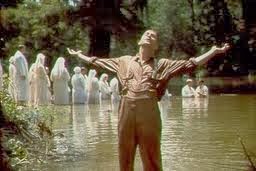
Tim Blake Nelson finds salvation as the baptismal choir sings "Down To The River To Pray"   in "O Brother, Where Art Thou?"
 
Certainly, there’s a comparison to be made between the two films.  “O Brother, Where Art Thou?”  is the Coen’s loosely-based, sunny and often hilarious tour-de-force of Homer’s Odyssey. George Clooney’s main character (Ulysses) escapes prison with two fellow inmates (played by John Turturro and Tim Blake Nelson), in pursuit of great treasure, the location of which is known only to Ulysses.   In contrast, Llewyn Davis has a muted and depressing roundtrip journey to and from Chicago in search of glory and riches (well, hopefully enough riches to rent his own place). An orange tabby cat -  who Llewyn feels obliged to adopt and carry with him as he bums his way around the village and subsequent travels to Chicago – is also named Ulysses.  Musically speaking, the most compelling similarity between the two films (in addition to the inclusion of period American popular music),  is that so much of the period music in both films is performed and sung in real-time, with a few renditions even going beyond a couple of minutes in duration. 

"Lady Killers'" gospel music.


Beyond that however, the two films use their period songs for different dramatic purposes, resulting in a contrasting dynamic. “O  Brother’s” Blue grass, country and folk  songs are mainstream and culturally ubiquitous, ingeniously supporting scenes for baptisms, political rallies, an encounter with seductive sirens (an Odyssey reference) - even a Klu Klux Klan rally.  In fact, only the song “I Am a Man of Constant Sorrow”, spontaneously recorded by the soon to be very popular, Soggy Bottom Boys, is the only music actually used as a plot device, or part of the story.   The music in Llewyn Davis, however, is not mainstream, and representative of the 50s and early 60s folk counter culture.   Scorned by other musicians (such as John Goodman’s pompous and bloviating jazz musician), Llewyn struggles against selling-out when offered an opportunity to become a third wheel in a newly formed folk trio (a clear reference to Peter, Paul and Mary).  

But perhaps the most important distinction between the two films is the casting coup that gives us Oscar Isaac as the forlorn Llewyn Davis.  Mr. Isaac not only beautifully conveys Lleweyn’s anguish and ambivalence, but is actually a very accomplished singer and folk guitarist. The Coens have allowed him to perform live before the camera, something we suspect (despite their faultless lip-syncing) George Clooney, John Turturro, or even the Grand Wizard of the KKK (embodied by Wayne Duvall) are unable to accomplish - live or otherwise.  (In all fairness, Tim Blake Nelson, provides his own signing).    

Conversely, where “O Brother”  showers the audience with a colorful array of different vocal groups, Llewlyn Davis performs a solo (and as we soon learn),  lonely folk act.  When Mr. Isaac as Llewyn Davis opens this film singing “Hang Me, Oh Hang Me” sitting on the stage of an actual, West Village folk club, the Gaslight, he and the Coens seamlessly evoke a poignant trifecta of time, place - and character. 

(In passing, and in the same context, it’s worth drawing comparisons with the Coen’s 2004 film, “The Lady Killers”, which liberally uses African American gospel music).


 But, "No Country For Old Men" had no music on its soundtrack, whatsoever.

Thursday, January 3, 2013

5 Great (and Evocative) Instrumental Movie Themes (Part1)


Going back to the earliest days of early sound, Classic Movie themes have been designed to evoke time and place, identify characters, provide another dimension of emotional support for those characters and - in either explicit or ephemeral ways - underscore the film’s big messages. These themes, which might serve as title music, also provide the melodic and motivic material for creating additional parts of the score. (Of course, this classical approach is not shared by those films going as far back as 1973’s American Graffiti, which rely almost completely on pastiches of popular songs for their sound tracks).

While there’s no shortage of great movie themes, and this wisp of a list could certainly be replaced a hundred times over, the following five movie themes (thank you YouTube), are great examples of this art. (Caveat: Please keep in mind I fully understand there are dozens of great film composers and that Eric Korngold, John Williams, Howard Shore, Danny Elfin and Bernard Hermann – to name a very, very few - deserve their own lists).


1. A Summer’s Place (1959) Max Steiner

A pioneer of early film sound tracks - and the composer for 1933’s King Kong - Max Steiner wrote the tune for this nostalgic and highly memorable top-40s standard. The relaxed, summertime music is the love theme for two teenagers who have accompanied their respective parents to neighboring summer homes.

Steiner's love theme underscores the innocent interaction between the Sandra Dee and Troy Donahue characters, whose relationship soon turns to first love. We know it’s their music because Steiner’s simple, yet soaring string melody is scored over a typical, 50s Rock & Roll triplet accompaniment, supported by woodwinds and a subtle (for the time), pop rhythm section.

 "A Summers Place".


2.   Dr. No (1962) Monty Norman/John Barry

Monty who? The late John Barry scored 11 James Bond films, but actually did not write the Agent 007 Theme. Monty Norman, a lesser known theater composer, deserves that credit (and royalties). But Barry, in addition to creatively employing the theme and its motifs across all his Bond films (Dr. No through Octopussy), deserves the credit for first arranging Agent 007 signature theme in its iconic, jazzy style. 50 years after its debut – and dozens of James Bond films later - the signature 007 Theme has yet to be discarded and is still recognizable (if just barely), as in the most recent Bond production Sky Fall.

With its pungent harmonies, punchy, syncopated rhythms and cutting-edge scoring, this theme tells us everything we need to know about its protagonist. He’s a cool, sexy hipster who bests his opponents and always keeps his act together - despite engaging in highly dangerous and life threatening situations.

And everyone loves that final electric guitar chord: E Minor/Maj7/Maj9!


3. My Body Guard (1980) Dave Grusin

For this smaller budgeted indie sleeper, Dave Grusin makes an inspired choice. In scaling his instrumentation to a modestly sized chamber orchestra, he ingratiatingly supports My Body Guard's coming-of-age story and its wistful sense of nostalgia. A string quartet is used to good effect in evoking a youthful and sunny hopefulness. The main theme appears under the title, gracefully unfolding in ¾ time as Clifford, a high school student, rides his bike through the city of Chicago.

                                      " My Body Guard": Main theme and title music.